

From the World Cup to the Olympics: E-2 Visas and the New Wave of U.S. Investment

The massive commercial scale and mature capital ecosystem of the U.S. market.
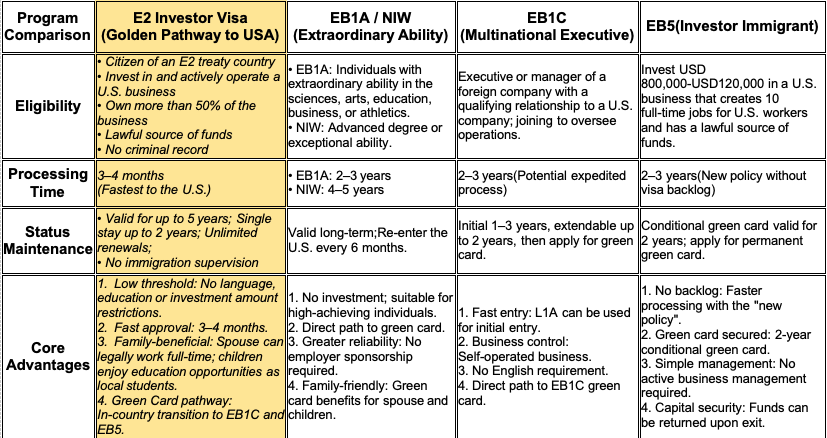
Comparison between the E-2 visa and current mainstream U.S. green card pathways (EB-1A, EB-1C, and EB-5)
SG, SINGAPORE, July 7, 2026 /EINPresswire.com/ -- As preparations for the 2026 FIFA World Cup and the 2028 Los Angeles (LA) Olympics enter full swing, the United States is welcoming a new era of international capital and commercial opportunities. According to various international business consultancies and industry economic forecasts, these two premier global sporting events are expected to generate tens of billions of dollars in direct economic growth for the U.S.
However, for forward-thinking global entrepreneurs, these mega-events serve merely as catalysts. The underlying reasons for the enduring appeal of the U.S. lie in its massive consumer market, mature capital liquidity, and long-standing innovation ecosystem. Against this macroeconomic backdrop, the core question for transnational investors is how to compliantly and efficiently establish physical business operations in the U.S. while securing legal status for long-term management. Among various options, the U.S. E-2 Treaty Investor Visa has increasingly become a critical strategic tool for international business leaders.
Why Global Entrepreneurs Are Re-evaluating the E-2 Visa
Historically, the primary focus of international talent and investment mobility has been permanent residency (such as the U.S. EB-5 Immigrant Investor Program). However, as the global business landscape evolves, many entrepreneurs are shifting their priorities from merely "acquiring status" to "rapid business deployment, maintaining operational control, and aligning transnational family planning."
The E-2 visa is a non-immigrant commercial visa offered by the U.S. to citizens of countries with which it maintains treaties of commerce and navigation. It allows applicants to legally reside in the U.S. by investing capital into a U.S. enterprise and actively directing its operations. Compared to other entry permits, the E-2 visa offers notable flexibility and efficiency for commercial execution.
Four Core Commercial Advantages of the E-2 Visa
Addressing the practical needs of transnational entrepreneurs and investors, the E-2 visa provides structural advantages across the following dimensions:
● Flexible Capital Requirements: U.S. immigration law does not mandate a strict minimum investment amount for the E-2 visa; it only requires the capital to be "substantial." In commercial practice, an initial investment of several hundred thousand dollars is often sufficient to support a compliant physical business (e.g., retail stores, food and beverage outlets, or light-asset services). Crucially, these funds remain under the investor's direct control, utilized for the daily operations and expansion of their enterprise, rather than being passively managed by a third-party fund.
● Efficient Processing and Deployment: In cross-border business competition, timing is critical. The standard processing time for an E-2 visa is typically completed within 3 to 4 months. Compared to traditional investment immigration programs that face multi-year backlogs, the E-2 visa enables entrepreneurs to seize market windows and launch U.S. operations rapidly.
● Favorable Family Accompaniment Policies: The E-2 visa supports not only the principal applicant but also provides comprehensive benefits for accompanying family members. Upon entry to the U.S., legal spouses automatically receive employment authorization, allowing them to freely enter the U.S. workforce. Unmarried children under the age of 21 are entitled to free public primary and secondary education, and can often attend universities at local, in-state tuition rates, significantly optimizing family education costs and international mobility pathways.
● Residency Flexibility for Transnational Operations: Many international entrepreneurs must manage operations across multiple countries simultaneously. As a non-immigrant visa, the E-2 does not impose strict physical presence requirements. It is typically granted for up to five years, allowing a maximum stay of two years per entry, and can be renewed indefinitely as long as the underlying enterprise maintains normal operations. Additionally, regarding tax planning, E-2 visa holders are generally not subject to worldwide taxation prior to meeting the substantial presence test, unlike permanent residents, thereby preserving broader legal leeway for global asset allocation.
Strategic Comparison: The E-2 Visa vs. Mainstream U.S. Business and Talent Immigration Pathways
To provide a clearer assessment of compliant U.S. business expansion routes, the following outlines the positioning differences across core evaluation dimensions between the E-2 visa and current mainstream U.S. green card pathways (EB-1A, EB-1C, and EB-5):
1. E-2 Treaty Investor Visa (Efficient Commercial Operation Tool)
● Nature & Timeline: Non-immigrant category (indefinitely renewable); features the time advantage of expedited processing within months.
● Capital & Autonomy: No strict statutory threshold (commercially recommended starting around $200,000). Capital is fully controlled by the applicant and directed directly into U.S. physical operations.
● Core Threshold & Audience: Requires a passport from a U.S. treaty country. Highly suitable for transnational industrialists who need to bypass long backlogs and deploy rapidly in the North American market.
2. EB-5 Immigrant Investor Program (Traditional Capital-Driven Pathway)
● Nature & Timeline: Immigrant category (conditional green card transitioning to permanent). Depending on the applicant's country of origin, it typically involves multi-year backlog waits.
● Capital & Autonomy: Strict investment threshold of $800,000 or $1,050,000. Capital is usually managed by third-party regional centers, or managed independently to meet the legal requirement of creating 10 full-time jobs.
● Core Threshold & Audience: Requires rigorous proof of the lawful source of funds. Ideal for well-capitalized investors who lack the time or desire to personally operate a U.S. business.
3.EB-1C Multinational Executive and Manager (Mature Corporate Expansion Pathway)
● Nature & Timeline: Immigrant category (permanent green card). Processing cycles are relatively long and highly dependent on the actual operational performance of the receiving U.S. entity.
● Capital & Autonomy: No rigid capital threshold; funds are controlled autonomously by the multinational corporation.
● Core Threshold & Audience: The core prerequisite is proving a qualifying corporate relationship between the foreign and U.S. entities, and the U.S. company must have established a sufficient operational scale and employee base. Suited for executives being transferred to the U.S. to oversee operations backed by a mature parent company structure.
4. EB-1A Alien of Extraordinary Ability (Top-Tier Professional Achievement Pathway)
● Nature & Timeline: Immigrant category (permanent green card). Eligible for premium processing, offering a shorter timeline.
● Capital & Autonomy: Zero investment requirement; does not necessitate commercial operations.
● Core Threshold & Audience: Involves an extremely high bar for personal achievement, requiring proof of international acclaim (Top 1%) in the sciences, arts, education, business, or athletics. Suited for globally recognized professionals and industry leaders.
(Note: The E-2 is fundamentally a non-immigrant visa. However, upon sustaining stable operations of the U.S. enterprise, applicants may legitimately submit an EB-1C or EB-5 application to transition to a permanent green card, depending on company scale and personal needs. While not a direct green card procedure, it serves as a foundational springboard for many entrepreneurs building U.S. operations.)
Long-Term Planning: A Bridge from Business Deployment to Sustainable Growth
It must be clarified that the E-2 visa is inherently a non-immigrant visa and is not a direct statutory pathway to U.S. permanent residency. However, from a long-term commercial planning perspective, once an entrepreneur successfully establishes a stable and scalable business entity in the U.S. via the E-2 visa, they have viable legal avenues to adjust their status to a permanent resident by applying for an EB-1C (Multinational Manager) or EB-5 (Immigrant Investor), depending on the business's growth and personal objectives.
Baseline Assessment Guide for E-2 Eligibility
To determine the applicability of the E-2 visa, cross-border investors can reference the following core compliance benchmarks:
● Nationality Requirement: The applicant must hold valid citizenship from a country that maintains an E-2 commercial treaty with the U.S. (e.g., Canada, South Korea, Japan, Singapore, Turkey, and over 80 other nations).
● Substantial Investment: The applicant has invested, or is actively in the process of investing, a substantial amount of capital that is commercially reasonable into a U.S. enterprise.
● Control and Operation: The applicant must own at least 50% of the U.S. enterprise and hold a critical managerial position, possessing absolute control over the company's management and financial allocation.
● Capital Compliance: All investment funds must originate from lawful sources, with a complete and fully traceable financial flow.
● Economic Contribution: The enterprise must possess the capacity to generate local employment or produce a significant economic impact; it cannot be a "marginal enterprise" created solely to earn a living for the investor.
Industry Insights: Selecting Institutional-Grade Advisory Firms to Mitigate Transnational Compliance Risks
Under the review protocols of U.S. consular officers, E-2 visa approval hinges not solely on capital volume, but heavily on the logical viability of the business plan, the legitimacy of fund sources, and the applicant's tangible managerial capability. Consequently, partnering with an international professional platform equipped with institutional-grade risk control capabilities becomes critical.
● Take Globevisa Group, an industry veteran, as an example. As a leading global high-net-worth wealth management and cross-border identity advisor, it demonstrates the following structural advantages in facilitating E-2 visas and transnational deployments:
● Massive Historical Success Volume: To date, the firm has successfully assisted over 120,000 high-net-worth families and clients globally in executing cross-border identity deployments, possessing profound practical experience in handling high-volume, complex capital compliance cases.
● Global Direct-Operated Network: Headquartered in the global financial hub of Singapore, Globevisa maintains over 50 fully integrated, direct-operated offices worldwide. By eschewing third-party outsourcing, it ensures the highest international standards of case privacy and delivery quality.
● Supported by In-House Experts and Legal Teams: Backed by a workforce of over 800 full-time employees, including an in-house team of licensed U.S. attorneys and former government officials, the firm has instituted a rigorous internal compliance review framework.
● Comprehensive North American Enablement: Leveraging local direct-operated offices in cities like New York and Los Angeles, its services extend beyond securing the E-2 business plan and legal documentation. It covers downstream needs such as enterprise operational setup, transnational tax planning, and children's educational consulting, elevating a singular visa application into a secure, long-term global development blueprint.
Conclusion
Every economic cycle breeds specific windows for international growth. As the 2026 and 2028 mega-events approach, the U.S. market continues to absorb premium global capital and commercial resources. For business decision-makers dedicated to expanding their North American footprint and achieving compliant global asset allocation, proactively utilizing efficient commercial tools like the E-2 visa for early deployment is vastly superior to waiting passively during lengthy processing backlogs. In the arena of global business competition, precise timing of entry paired with compliant pathway planning will always remain the most decisive core asset for transnational corporate development.
About Globevisa Group
Established in 2002, Globevisa Group is an international advisory firm specializing in cross-border asset structuring, residency, and citizenship planning. The firm is dedicated to providing high-net-worth clients with comprehensive, turnkey residency and identity frameworks that adhere strictly to top-tier international regulatory and compliance standards.
(Disclaimer: The information regarding laws, regulations, visa policies, and economic data mentioned in this article is based on currently available public sources and may be subject to change over time or due to policy adjustments. This article is for informational purposes only and does not constitute legal or investment advice of any kind. Investors should consult qualified U.S. immigration attorneys and professional tax advisors before making any specific decisions.)
Globevisa Group Team
Globevisa Group
email us here
Visit us on social media:
LinkedIn
Instagram
Facebook
YouTube
TikTok
X
Legal Disclaimer:
EIN Presswire provides this news content "as is" without warranty of any kind. We do not accept any responsibility or liability for the accuracy, content, images, videos, licenses, completeness, legality, or reliability of the information contained in this article. If you have any complaints or copyright issues related to this article, kindly contact the author above.
