

Luminary Launches New Secure Advanced Physics AI Models to Power U.S. Department of War by Air, Land and Sea
Advanced Physics AI Models for Collaborative Combat Aircraft drones, submarines, and pump systems accelerate design cycles and keeps military forces ahead of adversaries
SAN MATEO, Calif., Jan. 12, 2026 (GLOBE NEWSWIRE) -- Luminary Cloud, the leading Physics AI platform, today announced the release of three new defense AI models designed to dramatically expedite U.S. defense technology development while preserving American technological advantages. These new models include SHIFT-CCA (Collaborative Combat Aircraft), SHIFT-Submarine, and SHIFT-Pump which deliver secure, U.S. controlled Physics AI capabilities to Department of War (DoW) operations across air, maritime, and ground domains.
As global competitors race to weaponize AI, U.S. military leaders have repeatedly warned that speed and control of AI systems will determine future battlefield dominance. In response, the White House unveiled the Genesis Mission to accelerate AI-driven scientific discovery and national security. Physics AI predicts real world physical performance of engineered systems with speed and accuracy, enabling engineering analysis time to shrink from hours to seconds. This empowers defense contractors to explore larger design spaces and make informed decisions faster without relying on foreign or unsecured AI infrastructure.
Luminary’s new models were produced using its Physics AI Factory, an end-to-end, secure, U.S.-based platform purpose-built to design, train, and deploy Physics AI models inside trusted environments. The factory enables rapid, sovereign AI development by unifying GPU-native physics simulation, large-scale data generation, AI model training, and model deployment and inference into a single pipeline.
The new models expand upon the previously released SHIFT-SUV and SHIFT-Wing models for automotive and aerospace applications. SHIFT is a family of models that provide access to both high-quality datasets and pretrained models for a variety of applications and industries.
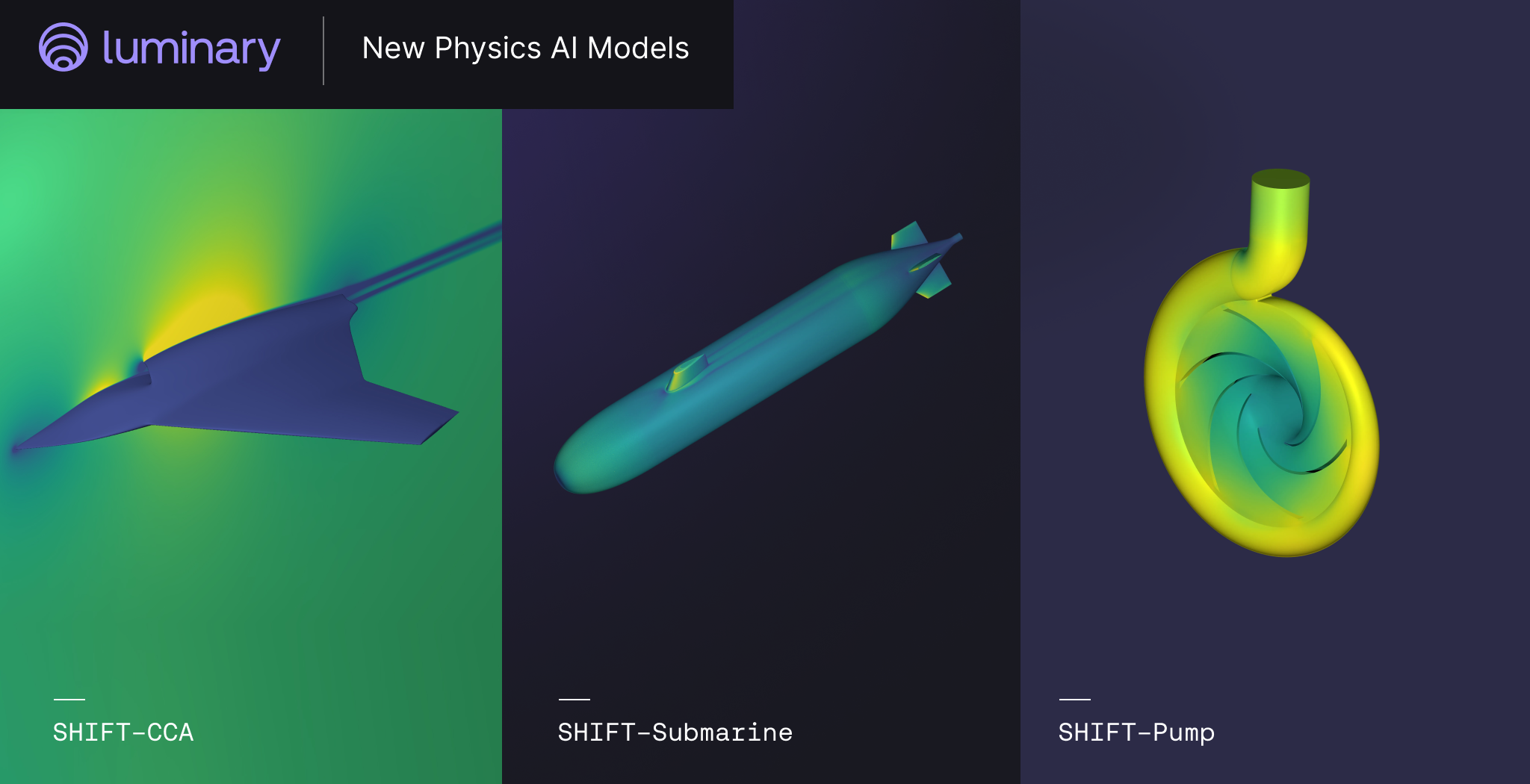
Defense benefits of the Physics AI models:
- SHIFT-CCA: Collaborative Combat Aircraft is a U.S. Air Force initiative for AI-driven, autonomous, unmanned drones to fly alongside crewed fighter jets to extend fighter capabilities and enhance situational awareness. The model is a tool for optimizing aerodynamic performance of CCA prototypes, which can impact fuel efficiency, extend mission duration, and enable specific collaborative maneuvering.
- SHIFT-Submarine: Submarines, including autonomous versions, are increasingly important to national security. The model is a tool to assess hydrodynamic efficiency and performance under constraints for internal hardware (batteries) capacity, impacting length and duration of missions.
-
SHIFT-Pump: Pumps and compressors are vital components in many defense and civilian operations, from fluid and heat management in aerospace systems and construction, to ground defense such as flood management and firefighting, as well as supplying clean water and commercial energy production. The model is a tool to optimize a new design for pressure, flow and efficiency.
All three models were designed and built from scratch, starting from high-quality synthetic training data generation. Each training dataset leveraged Luminary’s GPU-native physics simulators to run high-fidelity simulations across thousands of different vehicle designs. Each program exercised a different type of physics simulator, ranging across: high speed external aerodynamics (SHIFT-CCA), fully-submerged incompressible hydrodynamics (SHIFT-Submarine), and compressible rotating turbomachinery (SHIFT-Pump). Luminary’s Physics AI Factory was used to automate and orchestrate all of the training data generation and subsequent AI model training and deployment.
“If the DoW wants to outpace adversaries, Physics AI is not optional -- it is a mission-critical necessity. Platforms like Luminary are essential for compressing design timelines and securing the technological edge,” said Juan Alonso, CTO of Luminary. “The U.S. Defense Industrial Base is competing against adversaries operating at the frontier of AI and adopting Physics AI will be a decisive advantage. The Pentagon faces urgent needs across air, land and sea, and we purpose-built these new AI models specifically to meet those demands. From Collaborative Combat Aircraft drones to submarines and pump systems, Luminary is helping deliver the tools the country needs to design modern systems, faster and more effectively.”
Additional details about how each model was created will be shared in the next several months at upcoming industry conferences. For more information about SHIFT-CCA, attend the AIAA SciTech HUB talk by Juan Alonso titled “Strategies to Leverage Physics AI Surrogate Models for Spacecraft Design” on Wednesday, January 14 at 11-11:30 am and meet Luminary at Booth 206. Details on SHIFT-Submarine will be released during the WEST naval conference in San Diego in February and SHIFT-Pump information will be released in late January.
Luminary invites anyone to experience how the models work by trying the interactive demos at https://www.luminarycloud.com/demo/. To learn more about SHIFT Models, visit luminarycloud.com/models.
About Luminary Cloud
Luminary Cloud is a Physics AI platform for rapid design iteration, exploration, and optimization. Customers span industries from aerospace and automotive to advanced manufacturing, including Northrop Grumman, Otto Aerospace, Joby Aviation, Piper Aircraft, and Trek Bikes. For more information, visit www.luminarycloud.com.
Media Contact:
W2 Communications
A photo accompanying this announcement is available at https://www.globenewswire.com/NewsRoom/AttachmentNg/5884b833-8b62-43f4-b214-3eb44b4063e2

luminary@w2comm.com

Luminary Launches New Secure Advanced Physics AI Models
SHIFT-CCA, SHIFT-Submarine, and SHIFT-Pump deliver advanced, secure Physics AI capabilities to support rapid innovation across key defense domains.
Legal Disclaimer:
EIN Presswire provides this news content "as is" without warranty of any kind. We do not accept any responsibility or liability for the accuracy, content, images, videos, licenses, completeness, legality, or reliability of the information contained in this article. If you have any complaints or copyright issues related to this article, kindly contact the author above.
